Drilling 1600 special-shaped micro-holes on a hemispherical surface: Why traditional processes are incapable of realizing this requirement, and how Jiajiayong 5-axis laser processing breaks this technical bottleneck?
Technology News · 2026/10/30 · 14 views
A few days ago, the owner of a manufacturer specialized in precision filtration and atomization components came to me with a set of engineering drawings. He raised a processing requirement to machine 1,600 holes on a hemispherical surface that is 10cm in outer diameter and 1mm in wall thickness: 1,000 round holes with a 0.1mm aperture, 300 square holes with a side length of 0.5mm, 200 elongated slotted holes measuring 1cm × 0.2mm, and 100 special-shaped profiled holes. All holes are designed with a 0.3mm adjacent hole pitch, and zero burrs is set as a non-negotiable acceptance standard.
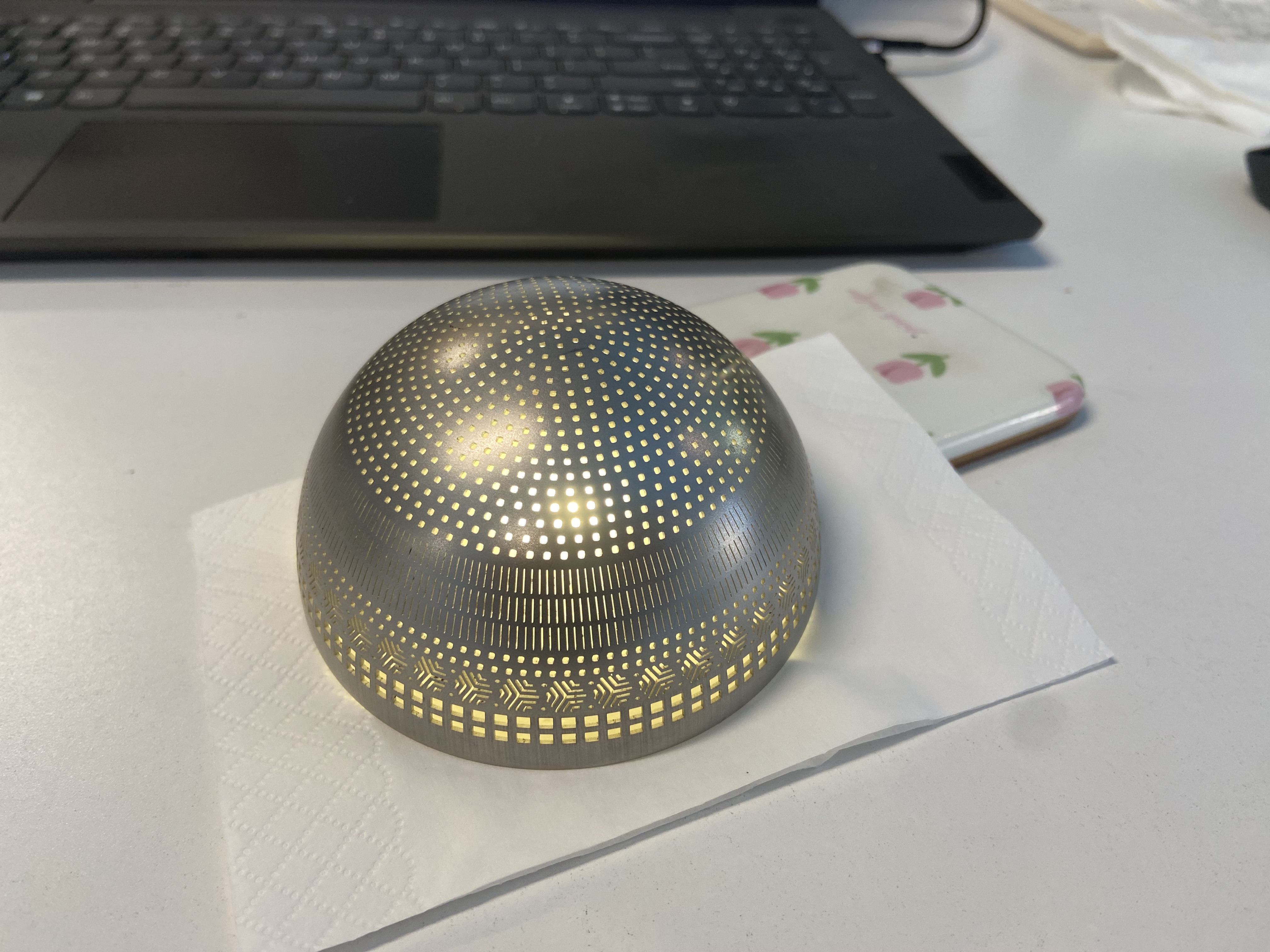
A few days ago, the owner of a factory specializing in precision filtration and atomization components came to us with a set of engineering drawings. He raised a highly demanding processing requirement: machine 1600 holes on a hemispherical part with 10cm outer diameter and 1mm wall thickness, including 1000 round holes (0.1mm aperture), 300 square holes (0.5mm side length), 200 elongated slotted holes (1cm × 0.2mm), and 100 custom special-shaped holes. All holes are designed with 0.3mm adjacent pitch, with a strict zero-burr acceptance requirement.
He had visited several processing suppliers before, only to get three outcomes: a flat refusal, an absurdly overpriced quotation, or a lead time far beyond his acceptable range.
This case is highly representative in the precision manufacturing field. Today we will use it to break down how to successfully deliver parts with such a complex "curved surface + micro-hole + special shape + high density" specification.
Ⅰ. Traditional mechanical drilling: Fails right at the first hurdle of curved surface processing
We can draw a clear conclusion at the very start: It is physically almost impossible to drill 0.1mm micro holes on a hemispherical surface with conventional mechanical drilling tools.
First, 0.1mm drill bits are already at the physical limit of industrial mass-produced mechanical tools.
The smallest practical industrial mechanical drill on the market is around 0.15mm, any diameter smaller than that is basically unworkable for mechanical processing, which requires laser alternatives. Even if you use a 0.15mm drill bit, it will break after drilling a few hundred holes on moderately hard materials. For 1600 holes, you will face dozens of drill breakages, and each tool change requires re-alignment. The accumulated positioning error will completely get out of control of the 0.3mm hole pitch precision requirement.
Second, curved surfaces are the fatal limitation of mechanical drilling
Mechanical drill bits must apply force perpendicular to the workpiece surface during operation, but the normal vector of every single point on the hemispherical surface varies. To make the drill bit tilt to follow the surface curve, you need high-precision 5-axis linkage machine tools matched with complex custom fixtures. The mold opening cost for such fixtures is completely uneconomical for small-batch production, not to mention the lead time of several months.
Third, the burr problem is fundamentally unsolvable.
Mechanical drilling will tear the material at the drill exit, leaving 0.02-0.05mm burrs on the edge of a 0.1mm hole. For zero-burr requirements, the subsequent deburring workload will far exceed the drilling process itself.
Ⅱ. Chemical etching: Cannot process 3D curved surfaces at all
Some may suggest using chemical etching? The fact is: current etching technology can barely deliver qualified parts on flat substrates, but it is completely powerless for 3D curved surfaces such as hemispheres, especially to produce 4 different hole types (round, square, slotted, special-shaped) at the same time.
Etching works by eroding material with corrosive chemical solutions, which requires even contact between the workpiece surface and the solution. Flat parts can be fully immersed, but the solution flow at the recessed area of a hemispherical surface is highly uneven, leading to inconsistent etching rates everywhere, making it impossible to control the aperture precision. Not to mention 4 different hole types need 4 separate sets of mask processes, which will push up complexity and cost to an unacceptable level.
Ⅲ. 5-axis laser processing: The only viable process route
To achieve high-quality machining of 1600 special-shaped micro-holes on a hemispherical surface, 5-axis simultaneous laser drilling equipment is a must. There are 3 core reasons for this:
1. Non-contact processing, with built-in curved surface adaptability
The laser beam works with the coordinated movement of two rotary axes: A-axis (tilting) and C-axis (rotation), so it can emit light at any angle perfectly aligned to the normal direction of the curved surface. No matter it is the top, equator or bottom of the hemisphere, the laser head can automatically adjust its posture to ensure the beam is perpendicular to the surface, so the hole shape will never deform caused by incident angle deviation.
2. Cold ablation mechanism, zero burr output
Adopting femtosecond or picosecond ultrafast laser, whose pulse duration is shorter than the electron-lattice coupling time of the target material. The material is directly gasified with almost no heat conduction. The machined hole wall is smooth, with no burrs, no recast layer and no microcracks on the edge. It is the only process that can meet the strict zero-burr requirement.
3. Any custom hole shape can be formed in one single pass
Round holes, square holes, slotted holes and special-shaped holes are essentially different laser scanning trajectories. Matched with dynamic focusing technology, the 5-axis linkage system can directly "draw" any shape of hole on the curved surface, no tool change, no mold opening and no secondary processing required.
Industrial-grade 5-axis femtosecond laser equipment can reach a positioning accuracy of ≤±1μm, aperture accuracy of ≤±1μm, and aspect ratio of up to 12:1, with no heat affected zone on the hole wall. That means the position accuracy and aperture consistency of all 1600 holes can be fully guaranteed, and the 0.3mm hole pitch tolerance can be stably controlled.
Ⅳ、Efficiency & cost: Laser solution far outperforms all traditional processes
Back to the filtration component manufacturer's case, we did a full cost and efficiency calculation for him:
1. Conventional mechanical drilling: Putting aside the fact that it cannot even process curved surfaces at all, if we calculate the comprehensive takt time of 30 seconds per hole (including tool change, alignment and processing) for 1600 0.1mm holes, it will take over 13 hours to process one single part. Adding the cost of custom molds and fixtures, the unit cost for small-batch production will be too high for the customer to afford.
2. 5-axis laser drilling: The processing time for a single micro hole is only 0.01-0.02 seconds, the pure processing time for 1600 holes is less than 1 minute. Including 5-axis path planning and curved surface scanning time, the comprehensive takt time per part is only 20-30 minutes, which is over 10 times more efficient than traditional mechanical drilling.
3.Low running cost: Laser processing is a consumable-free process, with power consumption as the major operating cost. No mold opening is required, production can start directly with submitted drawings, which is perfectly suitable for small-batch, high-mix, fast iteration customer scenarios.
4. Superior quality: Zero burr, no part deformation, 100% permeability, no secondary post-processing required.Most importantly, 5-axis laser equipment can run unattended 24/7 all year round. For this customer, the delivery lead time is compressed from "calculated by months" to "calculated by days", while the overall comprehensive cost is reduced by 30% to 50%.
Ⅴ、Which supplier to choose for 5-axis laser micro-hole drilling equipment?
There are a number of manufacturers on the market that produce 5-axis laser micro-processing equipment, but very few can meet all the strict requirements at the same time: ±1μm repeat positioning accuracy, curved surface adaptive processing, arbitrary custom hole shape, zero-burr output, and stable long-term operation, which requires decades of deep process accumulation.
Jiajiayong Laser has 29 years of technical expertise in this field, with in-depth cooperation with the Institute of Laser Engineering, Chinese Academy of Sciences. Our core capabilities include:
1. Processing capacity: Minimum machinable aperture of 0.003mm, drilling accuracy up to ±1μm, maximum processing speed of 100 holes per second.
2. Full hole type coverage: Can process arbitrary custom shapes including round holes, square holes, polygon holes, tapered holes, horn holes, blind holes, etc.
3. Full material compatibility: Supports all metal materials including gold, silver, copper, steel, iron and aluminum, as well as all non-metal materials including plastic, wood, leather.
4. Customization capability: Can integrate non-standard modules such as visual automatic alignment and production line integration. One single unit of our equipment can function as an independent micro-hole processing factory.
5. Responsive service: Free sample delivery on the same day, you can book a live video call to watch on-site sample testing anytime. We provide 7×24 hour phone support, and on-site troubleshooting service within 24 hours.
For complex curved surface micro-hole processing such as the hemispherical part in this case, Jiajiayong Laser's 5-axis positioning laser drilling equipment can achieve repeat positioning accuracy of ±1μm, excellent beam perpendicularity to the workpiece, with outstanding cost performance. Most importantly, our 29-year process database covers almost all common materials and hole specifications, short lead time for new project proofing and high first-pass yield are our core competitive advantages.
Ⅵ、Our advice for you: Start with sample testing, prove performance with actual data
For processing requirements as complex as 1600 special-shaped micro-holes on a hemispherical surface, no amount of theoretical analysis can beat one actual sample test. Here is our proposal:
Send your part drawings and raw material samples to our Application Verification Center in Shenzhen. We will finish the free sample processing within 3-5 working days, and deliver a full technical report including:
1. 5-axis path planning scheme and estimated processing takt time
2. Aperture CPK data and full hole pitch measurement report
3. SEM photos of the hole wall, to verify zero burr and no recast layer
4. Full cost comparison analysis between laser processing, mechanical drilling and chemical etching
If the result meets your expectation, we can have in-depth discussions on equipment configuration and production line integration. If not, you will at least get a set of professional, accurate technical data, which is highly valuable for your follow-up process decision making.
For 29 years, the unwavering mission of Jiajiayong Laser is to make every drilling task, no matter how difficult, fully achievable. No matter how challenging the special-shaped micro-hole processing on a hemispherical surface is, we are ready to work with you to find the optimal 5-axis laser processing solution.
Related Articles
- Stove Burner Nozzle Drilling: Precision Manufacturing Upgrade Starting from 0.003mm
- Over 10 million holes with a diameter of 0.1 mm: how can this drilling task be realized with conventional mechanical machining drilling processes?
- Key Quality Control Points for Laser Drilling of Mold Venting System: The Underlying Engineering Logic Behind the Surface Roughness Requirement of Ra < 0.4 μm